Eastern Cottontail Rabbit Baby Called Cottontail Rabbit Facts
| Eastern cottontail[1] | |
|---|---|
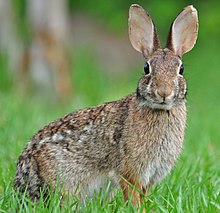 | |
| Male | |
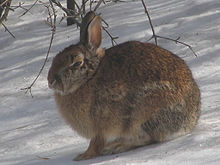 | |
| Female | |
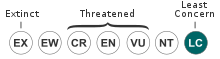
| Conservation status | |
| | |
Scientific nomenclature  | |
| Kingdom: | Animalia |
| Phylum: | Chordata |
| Grade: | Mammalia |
| Society: | Lagomorpha |
| Family: | Leporidae |
| Genus: | Sylvilagus |
| Species: | S. floridanus |
| Binomial name | |
| Sylvilagus floridanus (J. A. Allen, 1890) | |
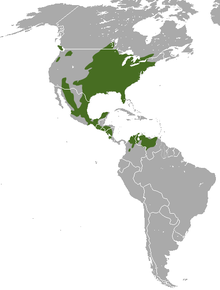 | |
| Eastern cottontail range (includes range of S. holzneri) | |
The eastern cottontail (Sylvilagus floridanus) is a New Globe cottontail rabbit, a member of the family Leporidae. It is the most common rabbit species in North America.
Distribution [edit]
The eastern cottontail can be found in meadows and shrubby areas in the eastern and south-central United States, southern Canada, eastern Mexico, Cardinal America and northernmost South America. It is too constitute on the Caribbean isle of Margarita. It is abundant in Midwest Due north America. Its range expanded north as forests were cleared past settlers.[3] Originally, information technology was not found in New England, but information technology has been introduced and at present competes for habitat at that place with the native New England cottontail. It has also been introduced into parts of Oregon, Washington, and British Columbia.[iv] In the mid-1960s, the eastern cottontail was introduced to northern Italy, where it displayed a rapid territorial expansion and increase in population density.[5]
The population in the mountains of the southwestern United States and western Mexico is now idea to be a distinct species, the robust cottontail (S. holzneri).[vi]
Habitat [edit]
Optimal eastern cottontail habitat includes open grassy areas, clearings, and onetime fields supporting abundant green grasses and herbs, with shrubs in the area or edges for cover.[7] The essential components of eastern cottontail habitat are an abundance of well-distributed escape cover (dense shrubs) interspersed with more open foraging areas such as grasslands and pastures.[eight] Habitat parameters important for eastern cottontails in ponderosa pine, mixed species, and pinyon (Pinus spp.)-juniper (Juniperus spp.) woodlands include woody debris, herbaceous and shrubby understories, and patchiness. Typically eastern cottontails occupy habitats in and around farms including fields, pastures, open up woods, thickets associated with fencerows, wooded thickets, forest edges, and suburban areas with acceptable food and comprehend. They are also found in swamps and marshes and commonly avert dumbo woods.[3]
Domicile range [edit]
The eastern cottontail dwelling range is roughly round in uniform habitats. Eastern cottontails typically inhabit i home range throughout their lifetime, merely home range shifts in response to vegetation changes and weather are common.[eight] In New England, eastern cottontail home ranges average 1.4 acres (0.57 hectares) for adult males and ane.2 acres (0.49 hectares) for adult females but vary in size from 0.five to twoscore acres (0.20 to 16.xix hectares), depending on season, habitat quality, and private. The largest ranges are occupied by adult males during the breeding flavour. In southwestern Wisconsin adult male person home ranges averaged 6.9 acres (2.8 hectares) in spring, increased to x acres (4.0 hectares) in early summertime, and decreased to iii.7 acres (ane.5 hectares) by tardily summer.[9] Daily activeness is usually restricted to 10% to xx% of the overall home range.[8]
In southeastern Wisconsin, home ranges of males overlapped by up to 50%, simply female person home ranges did not overlap by more than 25% and bodily defense of range by females occurred only in the immediate surface area of the nest. Males fight each other to establish dominance hierarchy and mating priority.[9]
Cover requirements [edit]
Eastern cottontails fodder in open areas and use brush piles, stone walls with shrubs around them, herbaceous and shrubby plants, and burrows or dens for escape cover, shelter, and resting cover. Woody embrace is extremely important for the survival and abundance of eastern cottontails.[8] Eastern cottontails exercise not dig their own dens (other than nest holes) simply utilize burrows dug by other species such as woodchucks.[3] In winter when deciduous plants are bare eastern cottontails forage in less secure cover and travel greater distances.[viii] Eastern cottontails probably utilise woody embrace more during the winter, specially in areas where cover is provided by herbaceous vegetation in summertime.[10] In Florida slash pine flatwoods, eastern cottontails use depression saw-palmetto (Serenoa repens) patches for comprehend within grassy areas.[11]

In nest, under production
Most nest holes are synthetic in grasslands (including hayfields).[8] The nest is concealed in grasses or weeds. Nests are besides synthetic in thickets, orchards, and scrubby woods.[iii] In southeastern Illinois alpine-grass prairie, eastern cottontail nests were more than common in undisturbed prairie grasses than in loftier-mowed or hayed plots. In Iowa about nests were inside lxx yd (64 m) of brush cover in herbaceous vegetation at to the lowest degree 4 in (10 cm) tall. Nests in hayfields were in vegetation less than 8 in (20 cm) tall. Boilerplate depth of nest holes is 5 in (xiii cm), average width v in (13 cm), and average length 7 in (18 cm). The nest is lined with grass and fur.[10] [12]
Description [edit]
The eastern cottontail is chunky, cherry-dark-brown or gray-brown in advent, with large hind feet, long ears, and a brusque, fluffy white tail. Its underside fur is white. There is a rusty patch on the tail. Its appearance differs from that of a hare in that it has a brownish-gray coloring effectually the head and neck. The torso is lighter color with a white underside on the tail. It has large brown eyes and large ears to come across and listen for danger. In winter the cottontail'south pelage is more gray than brown. The kits develop the same coloring after a few weeks, only they also have a white blaze that goes down their forehead; this marker somewhen disappears. This rabbit is medium-sized, measuring 36–48 cm (xiv–nineteen in) in full length, including a modest tail that averages 5.3 cm (2.i in).[13] [14] Weight tin range from i.8 to 4.4 lb (800 to two,000 g), with an average of around 2.6 lb (i,200 g). The female tends to be heavier, although the sexes broadly overlap in size.[15] [xvi] In that location may be some slight variation in the trunk size of eastern cottontails, with weights seeming to increase from south to north, in accordance with Bergmann's rule. Developed specimens from the Florida Museum of Natural History, nerveless in Florida, have a mean weight of ii.244 lb (i,018 g).[17] Meanwhile, 346 adult cottontails from Michigan were plant to have averaged 3.186 lb (one,445 grand) in mass.[eighteen]
Behavior [edit]
The eastern cottontail is a very territorial animal. When chased, information technology runs in a zigzag blueprint, running upwards to eighteen mph (29 km/h). The cottontail prefers an area where it can hide quickly, but be out in the open. Forests, swamps, thickets, bushes, or open areas where shelter is shut by are optimal habitation sites for this species. Cottontails practice not dig burrows, but rather residue in a class, a shallow, scratched-out depression in a clump of grass or under brush. It may use the dens of groundhogs as a temporary dwelling house or during heavy snow.[19]
Eastern cottontails are crepuscular to nocturnal feeders; although they normally spend most of the daylight hours resting in shallow depressions under vegetative cover or other shelter, they can be seen at any time of mean solar day.[12] Eastern cottontails are most agile when visibility is limited, such as rainy or foggy nights.[three] Eastern cottontails usually move only short distances, and they may remain sitting very nonetheless for up to a few hours at a time. Eastern cottontails are active twelvemonth-round.[12]
Reproduction [edit]

Litter and nesting material


Juvenile, unknown age, showing white blaze on forehead
The onset of breeding varies between populations and inside populations from year to year. The eastern cottontail breeding season begins later with higher latitudes and elevations. Temperature rather than diet has been suggested as a primary cistron decision-making onset of breeding; many studies correlate severe weather with delays in the onset of breeding.[20] In New England breeding occurs from March to September. In New York the convenance season occurs from Feb to September, in Connecticut from mid-March to mid-September. In Alabama the convenance flavor begins in January. In Georgia the breeding flavour lasts nine months and in Texas convenance occurs year-circular.[12] [20] Populations in western Oregon breed from tardily Jan to early September.[twenty] Mating is promiscuous.[three]
The nest is a slanting hole dug in soft soil and lined with vegetation and white fur from the female parent's underside. The average measurements are: length 7.09 in (eighteen cm), width 4.9 in (12 cm), and depth iv.71 in (12 cm).[10] The boilerplate period of gestation is 28 days, ranging from 25 to 35 days.[12] Eastern cottontail immature are born with a very fine coat of hair and are blind. Their optics begin to open by four to seven days. Young begin to move out of the nest for brusk trips past 12 to 16 days and are completely weaned and independent by four to five weeks.[x] [21] Litters disperse at about seven weeks. Females do not stay in the nest with the immature but render to the opening of the nest to nurse, usually twice a 24-hour interval.[12] [21]
Reproductive maturity occurs at about two to three months of age. A majority of females first breed the spring post-obit birth; but ten% to 36% of females breed equally juveniles (i.e., summer of the year they were born).[22] Males will mate with more one female. Female rabbits tin accept i to seven litters of one to twelve immature, called kits, in a yr; however, they boilerplate three to four litters per year, and the average number of kits is 5.[14] In the southern states of the United States, female eastern cottontails take more litters per year (up to seven) but fewer young per litter.[12] [20] In New England female eastern cottontails take three or iv litters per year. The almanac productivity of females may be as loftier every bit 35 young.[12] [21]
Nutrition [edit]
The diet of eastern cottontails is varied and largely dependent on availability. Eastern cottontails consume vegetation about exclusively; arthropods take occasionally been constitute in pellets.[23] Some studies listing as many as lxx[23] to 145 establish species in local diets. Food items include bark, twigs, leaves, fruit, buds, flowers, grass seeds, sedge fruits, and rush seeds.[10] There is a preference for minor textile: branches, twigs, and stems up to 0.25 in (0.64 cm). Leporids including eastern cottontails are coprophagous, producing two types of fecal pellets, ane of which is consumed. The redigestion of pellets profoundly increases the nutritional value of dietary items.[10] [12]
In summer, eastern cottontails eat tender greenish herbaceous vegetation when information technology is available. In many areas Kentucky bluegrass (Poa pratense) and Canada bluegrass (P. compressa) are important dietary components.[twenty] Other favored species include clovers (Trifolium spp.) and crabgrasses (Digitaria spp.).[7] In Connecticut important summer foods include clovers, alfalfa, timothy (Phleum pratense), bluegrasses (Poa spp.), quackgrass (Elytrigia repens), crabgrasses, redtop (Agrostis alba), ragweed (Ambrosia psilostachya), goldenrods (Solidago spp.), plantains (Plantago spp.), chickweed (Stellaria media), and dandelion (Taraxacum officinale). Eastern cottontails also consume many domestic crops.[3]
During the dormant season, or when green vegetation is covered with snowfall, eastern cottontails consume twigs, buds, and bawl of woody vegetation.[vii] In Connecticut, of import winter foods include gray birch (Betula populifolia), red maple, and polish sumac (Rhus glabra).[23]
Mortality [edit]
In Kansas, the largest crusade of mortality of radiotracked eastern cottontails was predation (43%), followed by deaths due to the research process (19%), and tularemia (18%).[24] A major crusade of eastern cottontail mortality is collision with automobiles. In Missouri, it was estimated that x eastern cottontails are killed annually per mile of route. The acme catamenia of highway mortality is in bound (March through May); roadside vegetation greens upwards before adjacent fields and is highly attractive to eastern cottontails.[22]
Annual adult survival is estimated at 20%. Average longevity is xv months in the wild; the longest-lived wild individual on record was five years old. Captive eastern cottontails accept lived to at to the lowest degree nine years of age.[12]
Eastern cottontails are hosts to fleas, ticks, lice, cestodes, nematodes, trematodes, grey mankind fly larvae, botfly larvae, tularemia, shopes fibroma, torticollis, and cutaneous streptothricosis.[iii] Farther summary of diseases and pests is bachelor.[x]
Predators [edit]
The eastern cottontail has to argue with many predators, both natural and introduced. Due to their often large populations in Eastern Northward America, they form a major component of several predators' diets. Major predators of eastern cottontail include domestic cats and dogs, foxes (Vulpes and Urocyon spp.), coyote (C. latrans), bobcat (Lynx rufus), weasels (Mustela spp.), raccoon (Procyon lotor), mink (M. vison), great horned owl (Bubo virginianus), barred owl (Strix varia), hawks (principally Buteo spp.), corvids (Corvus spp.), and snakes.[3]
Predators that take nestlings include raccoon, badger (Taxidea taxus), skunks (Mephitis and Spilogale spp.), and Virginia opossum (Didelphis virginiana).[22] In central Missouri, eastern cottontails comprised the bulk of biomass in the diet of red-tailed hawks (Buteo jamaicensis) during the nesting flavour. In Pennsylvania, the master predator of eastern cottontails is the great horned owl.[22] In the Southwest cottontails including eastern cottontail contain 7 to 25% of the diets of northern goshawk (Accipiter gentilis). In Texas, eastern cottontails are preyed on by coyotes more heavily in early jump and in fall than in summertime or winter. In southwestern Northward Dakota, cottontails (both eastern and desert cottontail Sylvilagus auduboni) were major prey items in the diets of bobcats.[25]
Juvenile eastern cottontails are rare in the nutrition of brusque-eared owls (Asio flammeus). Trace amounts of eastern cottontail remains have been detected in black bear (Ursus americanus) scat.[26]
Classification [edit]
Recognized subspecies of Sylvilagus floridanus [1]
- North of Mexico
- Sylvilagus floridanus alacer
- Sylvilagus floridanus chapmani
- Sylvilagus floridanus floridanus
- Sylvilagus floridanus mallurus
- Mexico and Central America
- Sylvilagus floridanus aztecus
- Sylvilagus floridanus connectens
- Sylvilagus floridanus hondurensis
- Sylvilagus floridanus macrocorpus
- Sylvilagus floridanus orizabae
- Sylvilagus floridanus yucatanicus
- South of Isthmus of Panama
- Sylvilagus floridanus avius
- Sylvilagus floridanus cumanicus
- Sylvilagus floridanus margaritae
- Sylvilagus floridanus nigronuchalis
- Sylvilagus floridanus orinoci
- Sylvilagus floridanus purgatus
- Sylvilagus floridanus superciliaris
References [edit]
 This commodity incorporates public domain material from the United States Department of Agriculture document: "Sylvilagus floridanus".
- ^ a b Hoffman, R.S.; Smith, A.T. (2005). "Order Lagomorpha". In Wilson, D.E.; Reeder, D.M (eds.). Mammal Species of the Globe: A Taxonomic and Geographic Reference (3rd ed.). Johns Hopkins University Press. pp. 209–210. ISBN978-0-8018-8221-0. OCLC 62265494.
- ^ Nielsen, C.; Lanier, H.C. (2019). "Sylvilagus floridanus". IUCN Red List of Threatened Species. 2019: e.T41299A45191626. doi:10.2305/IUCN.UK.2019-1.RLTS.T41299A45191626.en . Retrieved eighteen February 2022.
- ^ a b c d e f k h i Godin, Alfred J. (1977). Wild mammals of New England. Baltimore, Medico: The Johns Hopkins University Press
- ^ Reid, Fiona (2006). A Field Guide to Mammals of North America. New York, New York: Houghton Mifflin Company.
- ^ Silvano, Fabrizio; Acquarone, Camilla; Cucco, Marco (2000). "Distribution of the eastern cottontail Sylvilagus floridanus in the province of Alessandria" (PDF). Hystrix. eleven: 75–78. Archived from the original (PDF) on 2013-10-29. Retrieved 2010-01-xiii .
- ^ Diersing, Victor E.; Wilson, Don E. (June 2021). "Systematics of the mountain-inhabiting cottontails (Sylvilagus) from southwestern United States and northern Mexico (Mammalia: Lagomorpha: Leporidae)". Proceedings of the Biological Social club of Washington. 134 (1): 42–79. doi:10.2988/006-324X-134.1.42. ISSN 0006-324X.
- ^ a b c Hon, Tip. (1981). "Effects of prescribed burn on furbearers in the Due south", pp. 121–128 in: Forest, Gene W. (ed.) Prescribed fire and wildlife in southern forests: Proceedings of a symposium; 1981 April half dozen–8; Myrtle Embankment, SC. Georgetown, SC: Clemson University, Belle W. Baruch Forest Science Institute
- ^ a b c d e f Allen, A. W. (1984). "Habitat suitability index models: eastern cottontail". FWS/OBS 0197-6087. Washington, DC: U.S. Department of the Interior, Fish and Wild fauna Service, Division of Biological Sciences, Western Energy Land Use Team
- ^ a b Trent, Tracey T.; Rongstad, Orrin J (1974). "Dwelling house range and survival of cottontail rabbits in southwestern Wisconsin". Journal of Wildlife Management. 38 (3): 459–472. doi:10.2307/3800877. JSTOR 3800877.
- ^ a b c d e f g Chapman, Joseph A.; Hockman, J. Gregory; Edwards, William R. (1982). "Cottontails: Sylvilagus floridanus and allies". In: Chapman, Joseph A.; Feldhamer, George A., eds. Wild mammals of North America. Baltimore, Medico: The Johns Hopkins University Printing. pp. 83–123. ISBN 9780801823534
- ^ Komarek, Roy. (1963). "Fire and the changing wildlife habitat", pp. 35–43 in: Proceedings of 2nd annual Tall Timbers burn down ecology conference; 1963 March 14–xv; Tallahassee, FL. Tallahassee, FL: Tall Timbers Research Station
- ^ a b c d e f yard h i j Nowak, Ronald M.; Paradiso, John L. (1983). Walker's mammals of the world. 4th edition. Baltimore, MD: The Johns Hopkins University Press
- ^ GAWW: Species Description Archived 2013-12-30 at the Wayback Machine. Naturalhistory.uga.edu. Retrieved 2012-12-20.
- ^ a b Mikita, K. (1999). Sylvilagus floridanus. Creature Diversity Web.
- ^ Elderberry, William H.; Sowls, Lyle Grand. (1942). "Body Weight and Sex Ratio of Cottontail Rabbits". The Journal of Wild animals Management. 6 (3): 203–207. doi:10.2307/3795902. JSTOR 3795902.
- ^ Eastern Cottontail (Sylvilagus floridanus). Nsrl.ttu.edu. Retrieved 2012-12-20.
- ^ "FLMNH Mammal Principal Database- Sylvilagus floridanus". Florida Museum of Natural History. Retrieved 2014-01-22 .
- ^ Craighead, J.J. & Craighead, F.C. (1956) Hawks, Owls and Wildlife. Wildlife Direction Institute, ISBN 0-486-22123-7.
- ^ Merritt, Joseph East. (1987) Guide to the Mammals of Pennsylvania, University of Pittsburgh Press, p. 123, ISBN 0822953935.
- ^ a b c d east Chapman, Joseph A.; Hockman, J. Gregory; Ojeda C.; Magaly M. (1980). "Sylvilagus floridanus" (PDF). Mammalian Species. 136 (136): i–8. doi:ten.2307/3504055. JSTOR 3504055.
- ^ a b c Wainright, Larry C. (1969). "A literature review on cottontail reproduction". Special Report xix. Denver, CO: Colorado Department of Game, Fish and Parks
- ^ a b c d Rue, Leonard Lee, III. (1965). Cottontail. New York: Thomas Y. Crowell Company
- ^ a b c Dalke, Paul D.; Sime, Palmer R (1941). "Nutrient habits of the eastern and New England cottontails". Journal of Wild fauna Management. 5 (2): 216–228. doi:ten.2307/3795589. JSTOR 3795589.
- ^ Baker, Rhonda J.; Gress, Robert J.; Spencer, Dwight 50. (Spring 1983). "Bloodshed and population density of cottontail rabbits at Ross Natural History Resevation, Lyon County, Kansas". Emporia Country Research Studies. 31 (i): five–46. Retrieved 2020-12-05 .
- ^ Trevor, John T.; Seabloom, Robert W.; Allen, Stephen H. (1989). "Food habits in relation to sex and age of bobcats from southwestern Due north Dakota". Prairie Naturalist. 21 (3): 163–168.
- ^ Hellgren, Eric C.; Vaughan, Michael R. (1988). "Seasonal food habits of blackness bears in Bully Dismal Swamp, Virginia – North Carolina". Proceedings of the Annual Conference of Southeastern Association of Fish and Wild fauna Agencies. 42: 295–305
External links [edit]
- Cotton wool Tail Rabbit, World Broad Outreach Plan of The Rouge Foundation
- Eastern Cottontail, Fletcher Wildlife Garden
Eastern Cottontail Rabbit Baby Called Cottontail Rabbit Facts
Source: https://en.wikipedia.org/wiki/Eastern_cottontail
0 Response to "Eastern Cottontail Rabbit Baby Called Cottontail Rabbit Facts"
Post a Comment