Write the Formulas and Names of Compounds of 4 Manganese With Oxygen and Again With Bromine
Chapter 2. Atoms, Molecules, and Ions
2.iv Chemic Formulas
Learning Objectives
By the end of this section, yous will be able to:
- Symbolize the composition of molecules using molecular formulas and empirical formulas
- Represent the bonding arrangement of atoms inside molecules using structural formulas
A molecular formula is a representation of a molecule that uses chemic symbols to bespeak the types of atoms followed by subscripts to show the number of atoms of each blazon in the molecule. (A subscript is used just when more than than one atom of a given blazon is nowadays.) Molecular formulas are also used as abbreviations for the names of compounds.
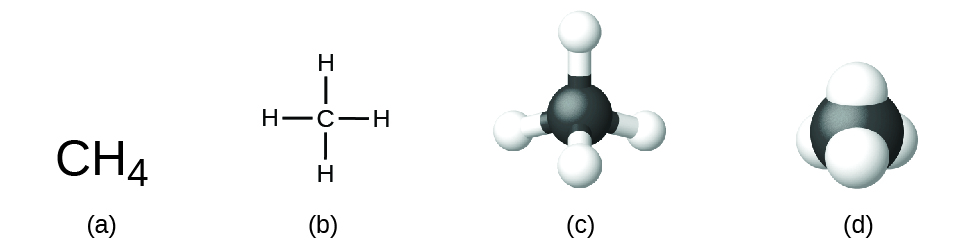
The structural formula for a chemical compound gives the same information as its molecular formula (the types and numbers of atoms in the molecule) just besides shows how the atoms are continued in the molecule. The structural formula for methane contains symbols for one C atom and four H atoms, indicating the number of atoms in the molecule (Figure 1). The lines represent bonds that concur the atoms together. (A chemical bail is an attraction betwixt atoms or ions that holds them together in a molecule or a crystal.) We will discuss chemical bonds and come across how to predict the arrangement of atoms in a molecule later. For now, just know that the lines are an indication of how the atoms are connected in a molecule. A ball-and-stick model shows the geometric arrangement of the atoms with diminutive sizes not to scale, and a space-filling model shows the relative sizes of the atoms.
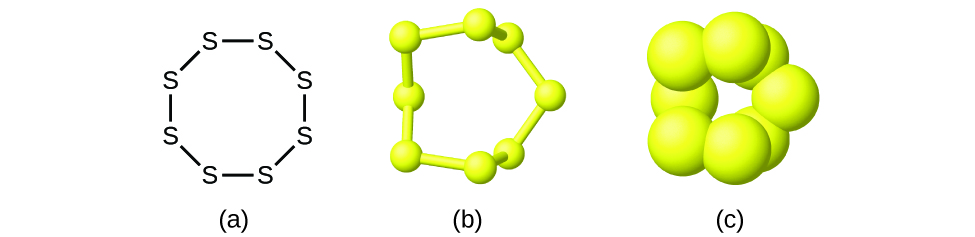
Although many elements consist of detached, private atoms, some exist as molecules fabricated upwards of two or more atoms of the element chemically bonded together. For example, virtually samples of the elements hydrogen, oxygen, and nitrogen are composed of molecules that incorporate two atoms each (called diatomic molecules) and thus accept the molecular formulas Hii, O2, and North2, respectively. Other elements commonly found as diatomic molecules are fluorine (F2), chlorine (Cl2), bromine (Brtwo), and iodine (I2). The most common form of the element sulfur is composed of molecules that consist of eight atoms of sulfur; its molecular formula is Seight (Figure two).
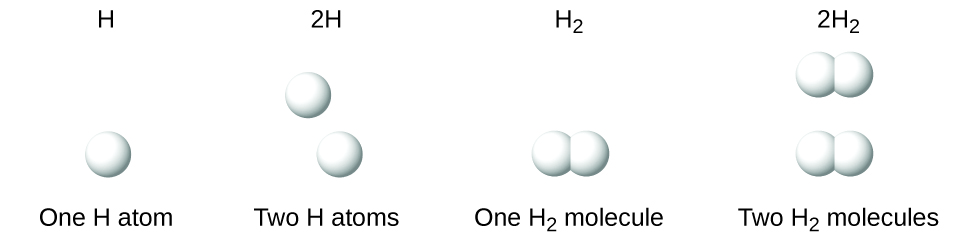
It is of import to note that a subscript following a symbol and a number in front of a symbol practice not represent the same thing; for instance, Hii and 2H represent distinctly unlike species. H2 is a molecular formula; it represents a diatomic molecule of hydrogen, consisting of two atoms of the chemical element that are chemically bonded together. The expression 2H, on the other mitt, indicates ii split up hydrogen atoms that are not combined as a unit. The expression 2Hii represents two molecules of diatomic hydrogen (Figure 3).
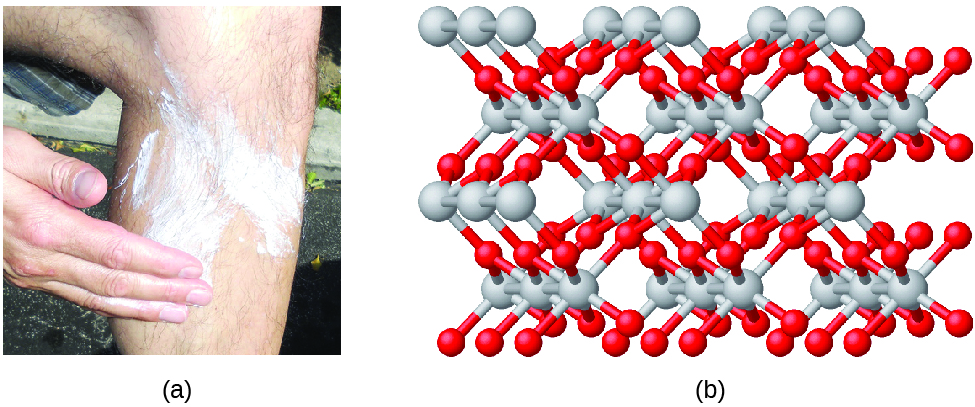
Compounds are formed when two or more elements chemically combine, resulting in the formation of bonds. For instance, hydrogen and oxygen tin can react to class water, and sodium and chlorine can react to form table table salt. We sometimes describe the limerick of these compounds with an empirical formula, which indicates the types of atoms present and the simplest whole-number ratio of the number of atoms (or ions) in the chemical compound. For example, titanium dioxide (used as paint in white paint and in the thick, white, blocking blazon of sunscreen) has an empirical formula of TiO2. This identifies the elements titanium (Ti) and oxygen (O) every bit the constituents of titanium dioxide, and indicates the presence of twice as many atoms of the element oxygen as atoms of the element titanium (Figure 4).
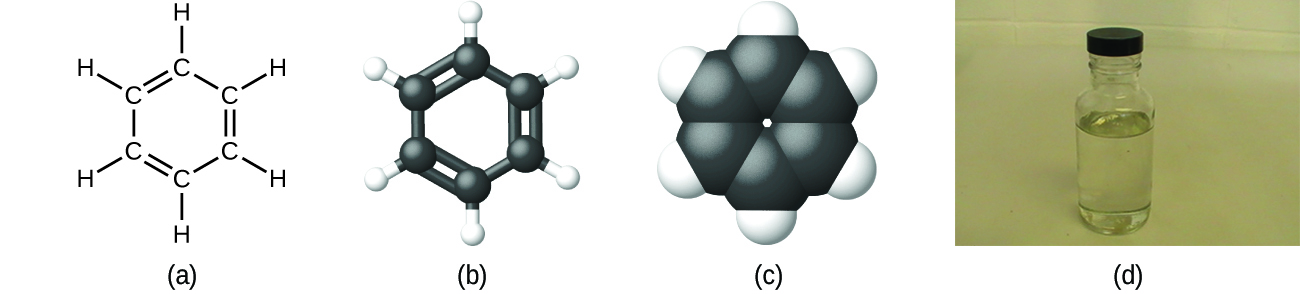
Equally discussed previously, we tin draw a compound with a molecular formula, in which the subscripts indicate the actual numbers of atoms of each element in a molecule of the compound. In many cases, the molecular formula of a substance is derived from experimental decision of both its empirical formula and its molecular mass (the sum of atomic masses for all atoms composing the molecule). For case, it can be determined experimentally that benzene contains two elements, carbon (C) and hydrogen (H), and that for every carbon cantlet in benzene, in that location is i hydrogen cantlet. Thus, the empirical formula is CH. An experimental determination of the molecular mass reveals that a molecule of benzene contains 6 carbon atoms and 6 hydrogen atoms, and so the molecular formula for benzene is Chalf dozenHsix (Figure 5).
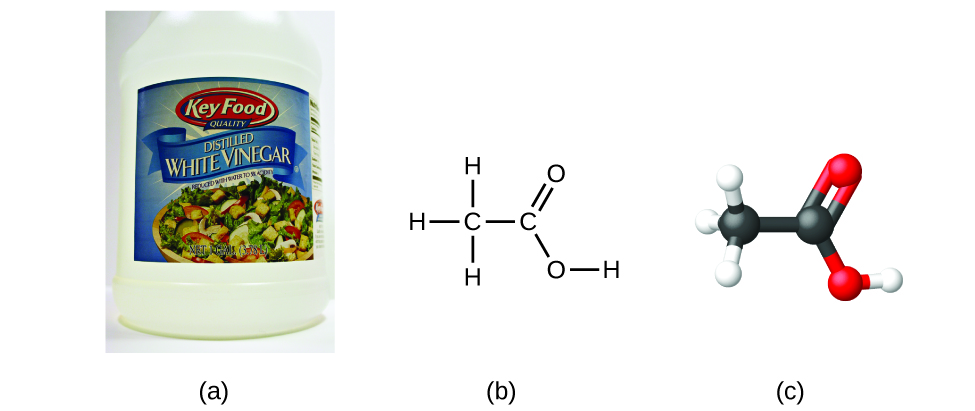
If we know a compound'south formula, we tin easily decide the empirical formula. (This is somewhat of an academic practise; the reverse chronology is generally followed in bodily practice.) For example, the molecular formula for acetic acrid, the component that gives vinegar its abrupt gustatory modality, is C2H4O2. This formula indicates that a molecule of acetic acrid (Effigy 6) contains 2 carbon atoms, four hydrogen atoms, and two oxygen atoms. The ratio of atoms is 2:iv:2. Dividing by the everyman mutual denominator (2) gives the simplest, whole-number ratio of atoms, i:2:one, so the empirical formula is CHtwoO. Annotation that a molecular formula is always a whole-number multiple of an empirical formula.
Example 1
Empirical and Molecular Formulas
Molecules of glucose (claret saccharide) contain six carbon atoms, 12 hydrogen atoms, and 6 oxygen atoms. What are the molecular and empirical formulas of glucose?
Solution
The molecular formula is C6H12Ohalf-dozen considering one molecule actually contains half-dozen C, 12 H, and 6 O atoms. The simplest whole-number ratio of C to H to O atoms in glucose is ane:2:i, so the empirical formula is CH2O.
Check Your Learning
A molecule of metaldehyde (a pesticide used for snails and slugs) contains eight carbon atoms, 16 hydrogen atoms, and four oxygen atoms. What are the molecular and empirical formulas of metaldehyde?
Answer:
Molecular formula, CviiiH16Oiv; empirical formula, C2HivO

You tin explore molecule building using an online simulation.
Lee Cronin
What is it that chemists practise? According to Lee Cronin (Figure 7), chemists make very complicated molecules by "chopping up" minor molecules and "reverse technology" them. He wonders if we could "make a really absurd universal chemistry ready" by what he calls "app-ing" chemistry. Could nosotros "app" chemistry?
In a 2012 TED talk, Lee describes one fascinating possibility: combining a drove of chemical "inks" with a 3D printer capable of fabricating a reaction apparatus (tiny test tubes, beakers, and the similar) to fashion a "universal toolkit of chemistry." This toolkit could exist used to create custom-tailored drugs to fight a new superbug or to "print" medicine personally configured to your genetic makeup, environment, and wellness state of affairs. Says Cronin, "What Apple did for music, I'd like to practise for the discovery and distribution of prescription drugs."[1] View his full talk at the TED website.

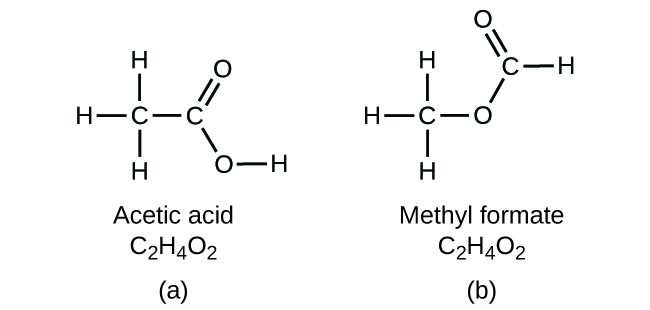
It is important to be aware that information technology may exist possible for the same atoms to be arranged in unlike ways: Compounds with the same molecular formula may have different atom-to-atom bonding and therefore different structures. For example, could there exist another chemical compound with the same formula as acetic acrid, CiiH4O2? And if so, what would exist the structure of its molecules?
If you lot predict that some other chemical compound with the formula C2H4O2 could be, then you demonstrated adept chemical insight and are correct. 2 C atoms, four H atoms, and two O atoms can also be bundled to grade a methyl formate, which is used in manufacturing, as an insecticide, and for quick-drying finishes. Methyl formate molecules have one of the oxygen atoms between the 2 carbon atoms, differing from the arrangement in acetic acid molecules. Acetic acrid and methyl formate are examples of isomers—compounds with the aforementioned chemic formula but different molecular structures (Figure 8). Note that this small difference in the arrangement of the atoms has a major effect on their respective chemical properties. Y'all would certainly not want to apply a solution of methyl formate as a substitute for a solution of acerb acid (vinegar) when you make salad dressing.
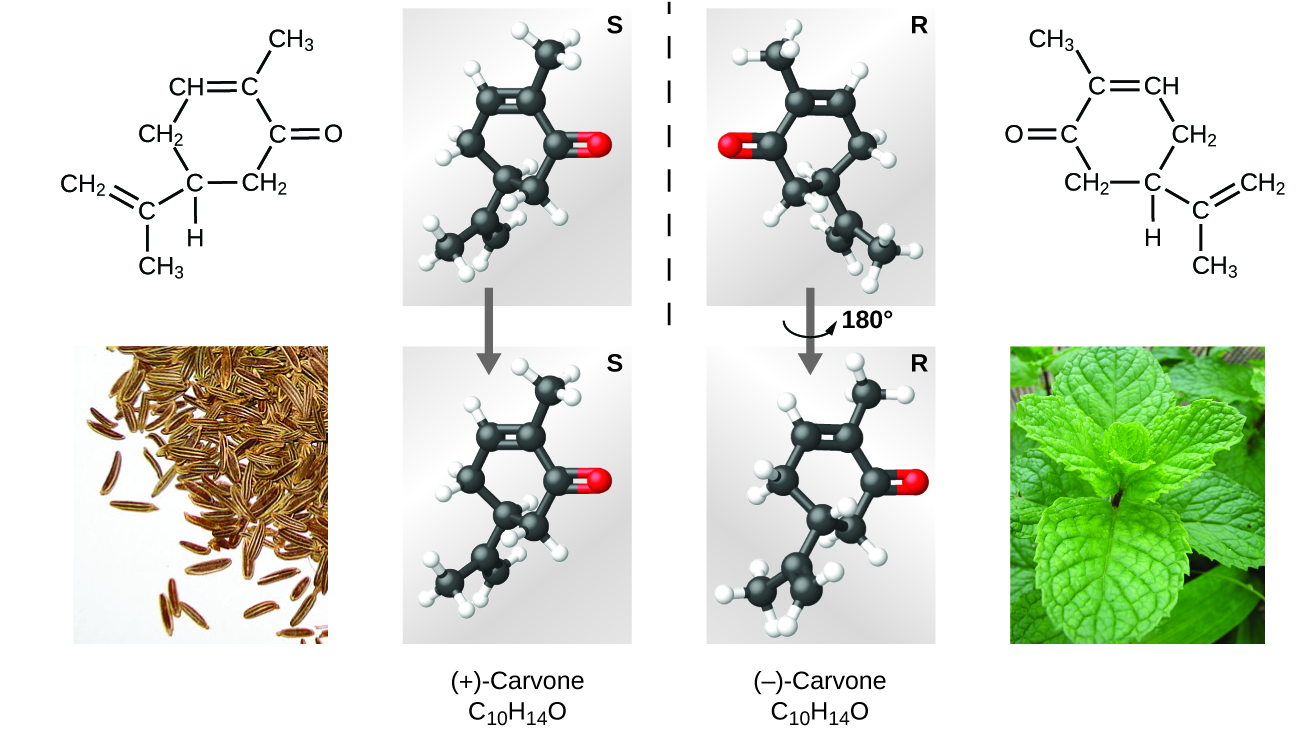
Many types of isomers exist (Effigy 9). Acetic acid and methyl formate are structural isomers, compounds in which the molecules differ in how the atoms are connected to each other. There are also various types of spatial isomers, in which the relative orientations of the atoms in space tin can be different. For example, the compound carvone (constitute in caraway seeds, spearmint, and mandarin orange peels) consists of ii isomers that are mirror images of each other. S-(+)-carvone smells similar caraway, and R-(−)-carvone smells like spearmint.
Select this link to view an explanation of isomers, spatial isomers, and why they have unlike smells (select the video titled "Mirror Molecule: Carvone").
Central Concepts and Summary
A molecular formula uses chemic symbols and subscripts to signal the exact numbers of dissimilar atoms in a molecule or compound. An empirical formula gives the simplest, whole-number ratio of atoms in a compound. A structural formula indicates the bonding organization of the atoms in the molecule. Ball-and-stick and space-filling models bear witness the geometric arrangement of atoms in a molecule. Isomers are compounds with the aforementioned molecular formula but unlike arrangements of atoms.
Chemistry Cease of Chapter Exercises
- Explain why the symbol for an atom of the element oxygen and the formula for a molecule of oxygen differ.
- Explain why the symbol for the element sulfur and the formula for a molecule of sulfur differ.
- Write the molecular and empirical formulas of the following compounds:
(a)

(b)

(c)
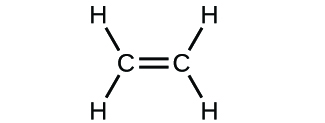
(d)
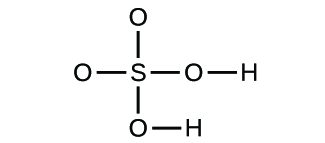
- Write the molecular and empirical formulas of the following compounds:
(a)
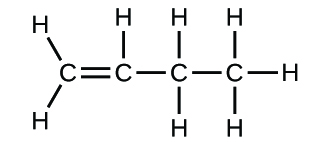
(b)
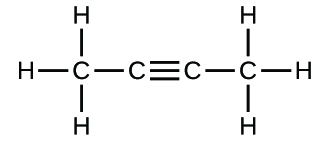
(c)
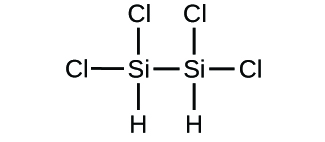
(d)
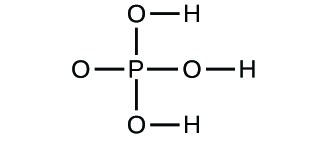
- Make up one's mind the empirical formulas for the following compounds:
(a) caffeine, CviiiH10Due north4O2
(b) fructose, C12H22O11
(c) hydrogen peroxide, H2O2
(d) glucose, CviH12O6
(e) ascorbic acid (vitamin C), C6H8Osix
- Determine the empirical formulas for the post-obit compounds:
(a) acetic acid, C2HivO2
(b) citric acid, CviHeightOvii
(c) hydrazine, Due north2H4
(d) nicotine, C10H14Due north2
(eastward) butane, C4H10
- Write the empirical formulas for the following compounds:
(a)
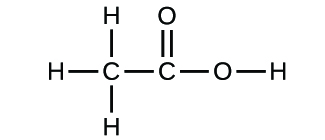
(b)

- Open up the Build a Molecule simulation and select the "Larger Molecules" tab. Select an appropriate atoms "Kit" to build a molecule with two carbon and six hydrogen atoms. Elevate atoms into the space above the "Kit" to make a molecule. A name will appear when you lot have fabricated an actual molecule that exists (fifty-fifty if it is not the ane you desire). Y'all can use the scissors tool to split atoms if you lot would similar to change the connections. Click on "3D" to meet the molecule, and look at both the space-filling and ball-and-stick possibilities.
(a) Draw the structural formula of this molecule and country its name.
(b) Tin can y'all arrange these atoms in whatsoever fashion to make a different chemical compound?
- Use the Build a Molecule simulation to repeat Chemistry End of Chapter Practise 8, merely build a molecule with two carbons, six hydrogens, and one oxygen.
(a) Draw the structural formula of this molecule and country its name.
(b) Tin you arrange these atoms to make a dissimilar molecule? If so, depict its structural formula and state its name.
(c) How are the molecules drawn in (a) and (b) the aforementioned? How do they differ? What are they chosen (the type of relationship between these molecules, non their names).
- Use the Build a Molecule simulation to repeat Chemistry Terminate of Chapter Practice 8, just build a molecule with 3 carbons, seven hydrogens, and one chlorine.
(a) Draw the structural formula of this molecule and state its name.
(b) Can you accommodate these atoms to brand a different molecule? If and so, draw its structural formula and land its proper name.
(c) How are the molecules drawn in (a) and (b) the same? How exercise they differ? What are they called (the type of relationship between these molecules, non their names)?
Glossary
- empirical formula
- formula showing the limerick of a chemical compound given as the simplest whole-number ratio of atoms
- isomers
- compounds with the same chemic formula but unlike structures
- molecular formula
- formula indicating the composition of a molecule of a compound and giving the actual number of atoms of each chemical element in a molecule of the compound.
- spatial isomers
- compounds in which the relative orientations of the atoms in space differ
- structural formula
- shows the atoms in a molecule and how they are connected
- structural isomer
- 1 of ii substances that have the same molecular formula simply different concrete and chemical properties because their atoms are bonded differently
Solutions
Answers to Chemistry Finish of Chapter Exercises
1. The symbol for the chemical element oxygen, O, represents both the element and one atom of oxygen. A molecule of oxygen, O2, contains two oxygen atoms; the subscript ii in the formula must be used to distinguish the diatomic molecule from ii single oxygen atoms.
3. (a) molecular CO2, empirical COii; (b) molecular C2H2, empirical CH; (c) molecular C2H4, empirical CH2; (d) molecular H2SO4, empirical H2So4
v. (a) CfourHvNorthward2O; (b) C12H22O11; (c) HO; (d) CHtwoO; (eastward) C3H4Othree
7. (a) CH2O; (b) C2H4O
9. (a) ethanol
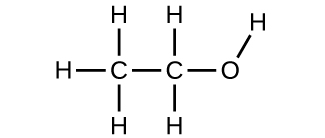
(b) methoxymethane, more than commonly known as dimethyl ether
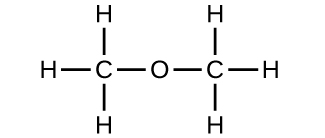
(c) These molecules have the same chemical composition (types and number of atoms) simply different chemical structures. They are structural isomers.
Source: https://opentextbc.ca/chemistry/chapter/2-4-chemical-formulas/
0 Response to "Write the Formulas and Names of Compounds of 4 Manganese With Oxygen and Again With Bromine"
Post a Comment